
TRIGGER
Use this as a visual sorting game to show that our *attitude* matters to God just as much as our actions, using Cain and Abel as the key example.
Materials
Setup
How to Play
Discussion and Faith Connection
“Best Attitude” Brainstorm
On the board, under “Right Attitude,” write ideas the kids suggest for giving their *best attitude* to God this week, such as:
Encourage them to each silently pick one “best attitude” idea to practice this week as an offering of the heart to God.
Materials
- Pictures that show different attitudes/actions (sharing, helping, whining, hitting, praying, rolling eyes, etc.)
- Poster board or whiteboard
- Marker or sticky notes for labels
Setup
- On the board, draw two columns and label them:
- “Right Attitude”
- “Wrong Attitude”
- Have your attitude/action pictures ready to hold up one at a time (or printed cards you can tape under each column).
How to Play
- Show one picture to the group and briefly describe it if needed (e.g., “This child is sharing toys,” or “This child is yelling at their parent”).
- Ask the children which column it belongs in: “Right Attitude” or “Wrong Attitude,” and why.
- Tape or place the picture in the chosen column, then repeat with more pictures until your columns are filling up.
- If a picture is tricky, use it to spark a short talk: “Is it the action, or the heart/attitude behind it, that really matters most?”
Discussion and Faith Connection
- Explain that Cain and Abel both brought offerings, but Abel’s was accepted because his heart and attitude toward God were right, while Cain’s heart was wrong—even though he still got something.
- Emphasize: God cares *how* we give, obey, and worship, not just *what* we do.
- Ask:
- “What might a ‘wrong attitude’ look like even when we’re doing something good (serving, giving, helping)?”
- “What does a ‘right attitude’ to God look like—at church, at home, at school?”
“Best Attitude” Brainstorm
On the board, under “Right Attitude,” write ideas the kids suggest for giving their *best attitude* to God this week, such as:
- Obeying parents the first time without complaining
- Helping a sibling with a happy heart
- Giving offering or sharing toys cheerfully, not grudgingly
- Praying and thanking God instead of grumbling
Encourage them to each silently pick one “best attitude” idea to practice this week as an offering of the heart to God.

CRAFT
Use this craft to contrast Abel’s right heart toward God with Cain’s wrong attitude, using two simple “altar” models and character drawings.
Materials
Steps: Characters and Offerings
Steps: Altars
Steps: Fire
Simple Application
Talk with the kids about how Abel brought his best with a loving, obedient attitude, while Cain’s heart was wrong, even though he brought something.
Emphasize that God still cares about the attitude behind what we give and do—He wants hearts that are trusting, thankful, and willing, not angry or selfish. Invite children to share one way they can bring God their “best heart” this week (in worship, obedience, kindness, or giving).
Materials
- Drawing paper
- Construction paper (grey/brown for altars; other colors for baskets, vegetables, fruit, sheep)
- Yellow, orange, and red tissue paper
- Markers or crayons
- 2 plastic or paper cups (for altar bases)
- Glue
- Scissors
Steps: Characters and Offerings
- Give each child drawing paper and markers/crayons.
- Ask them to draw:
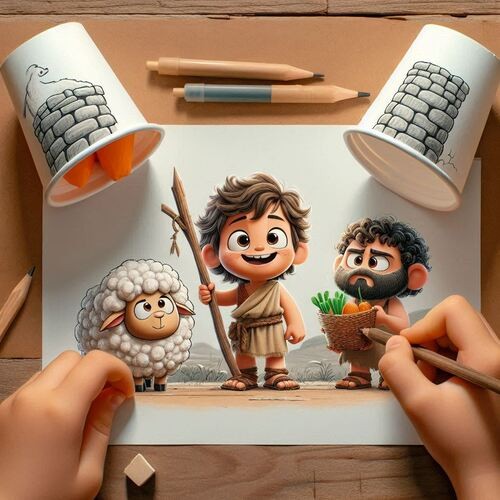
- Abel with a happy face, holding a sheep (his best offering to God).
- Cain, with an angry face, is holding a basket of vegetables (showing his wrong attitude).
- Optionally, they can cut out simple shapes from construction paper for the basket, vegetables, fruit, and sheep and glue them onto their drawings.
Steps: Altars
- Turn two cups upside down to become altar bases.
- Wrap each cup with grey or brown construction paper and glue it in place.
- Let children draw “stones” on the paper to make the altars look like stone piles.
- Label one altar “Abel” and glue the label onto one cup; label the other “Cain” and glue it onto the second cup.
Steps: Fire
- Cut small strips of tissue paper (yellow, orange, red), about 3–4 inches long.
- Have children glue the tissue strips to the top of Abel’s altar to show God accepting his offering with “fire.”
- Leave Cain’s altar plain on top (or with very little tissue) to picture that God did not look with favour on his offering because of his heart.
Simple Application
Talk with the kids about how Abel brought his best with a loving, obedient attitude, while Cain’s heart was wrong, even though he brought something.
Emphasize that God still cares about the attitude behind what we give and do—He wants hearts that are trusting, thankful, and willing, not angry or selfish. Invite children to share one way they can bring God their “best heart” this week (in worship, obedience, kindness, or giving).
GAME
Use this as a fast-paced object lesson to show that offerings given to God should be handled carefully and with a sincere heart, like Abel’s.
Materials
Setup
How to Play
Discussion and Application
Materials
- Clothespins (one per child)
- Coins (or other small items) – at least one per team
- Space for children to sit in two circles
Setup
- Divide the group into two teams and have each team sit in its own circle.
- Give every child a clothespin and give *one* coin to each team (not one per child), explaining that the coin represents an offering to God.
How to Play
- Show the children how to hold the clothespin and use it like “tongs” to grip the coin.
- Start the coin with one child on each team.
- At your signal, children must pass the coin around their circle using only clothespins—no hands touching the coin directly.
- The first team to pass the coin all the way around the circle and back to the starting child “wins” that round.
- Play a few rounds, switching the starting person so everyone gets a chance to begin.
Discussion and Application
- Ask: “Was it easy or hard to pass the coin carefully?” “Did it take focus and effort?”
- Explain that Abel’s offering pleased God because it came from a sincere, trusting heart, not just from his hands.
- Connect the game: Just as they had to be careful and intentional with the coin, God wants them to be thoughtful and sincere when they give—whether it’s money, time, or obedience.
- Invite them to share one way they can bring God an offering with a “right heart” this week (helping at home, sharing, giving, worshiping with focus).

CREATIVE SNACK
Let kids build a colorful “fruit offering” to picture giving their best to God from a happy, willing heart, like Abel.
Ingredients / Materials
Activity Steps
Discussion
Ingredients / Materials
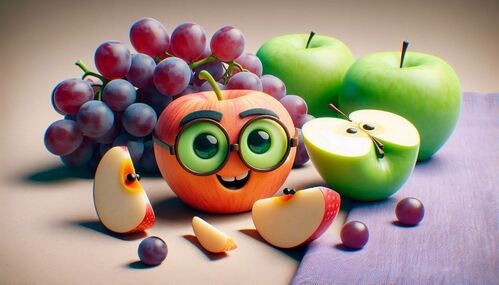
- Assorted fresh fruits: grapes, apple slices, banana slices, berries, etc.
- Plates (paper or plastic)
- Napkins and wipes
- Optional: small cups of water or juice
Activity Steps
- Give each child a plate and a selection of fruit pieces.
- Explain that they will create their own “offering plate” using the fruit, arranging it in a way that looks special and beautiful to them.
- Encourage them to:
- Choose their “best” pieces of fruit (not the squished or bruised ones).
- = Arrange the fruit thoughtfully—as a heart, a cross, a pattern, or a “basket” shape.
- Once everyone is finished, pause before eating and have the children hold up their plates as “fruit offerings.”
Discussion
- Share briefly that Abel gave his best to God from a sincere, trusting heart, and that is why his offering pleased God.
- Ask:
- “What does it mean to give God our *best* and not just our leftovers?”
- “Besides fruit or money, what are some ways we can give our best to God—at home, at school, at church?”
- Invite children to quietly thank God for His good gifts and ask Him to help them give their “best” attitudes, efforts, and obedience to Him this week.
OBJECT LESSON
Use this as a simple visual activity to contrast grumpy giving with joyful giving and to anchor 2 Corinthians 9:7.
Materials
How to Play
Discussion
Materials
- Two hand-drawn faces on separate sheets:
- One smiling face
- One frowning face
How to Play
- Hold up the frowning face and briefly describe a “grumpy giver,” for example:
- Gives to God or others only because they feel forced.
- Complains, rolls their eyes, or thinks, “I wish I could keep this for myself.”
- Then hold up the smiling face and describe a “cheerful giver,” for example:
- Is excited to give to God.
- Feels thankful for what God has given and wants to share.
- Gives with a happy heart, not just with their hands.
- Read 2 Corinthians 9:7 aloud, emphasizing the phrase “God loves a cheerful giver.”
- Ask children to point or move to the face that shows how they *want* to give to God.
Discussion
- Ask questions such as:
- “How do you feel when you *have* to give or help?”
- “How is it different when you *want* to give or help?”
- Talk about ways to be cheerful givers:
- With money (offering, sharing what they have).
- With actions (helping parents, siblings, friends).
- With service (helping at church, encouraging others).
- Invite children to choose one specific way they will be a “smiling-face giver” to God this week and, if appropriate, close with a short prayer asking God for cheerful hearts.